
The sociologist Judy Wajcman has noted, “there is a widespread perception that life these days is faster than it used to be”. Social acceleration is the idea given to the overwhelming, collective feeling that life is constantly speeding up; that time is slipping away, purportedly driven by a culture where technological progress forces us to rush through our days just to keep from falling behind. The most comprehensive account of social acceleration is found in Hartmut Rosa’s 2013 work, Social Acceleration: A New Theory of Modernity. Rosa defines three systems of social acceleration - technological acceleration, the acceleration of social change, and the acceleration of the pace of life.
From Horse-Drawn Carriages to Streaming
For Rosa, technological acceleration refers to the rapid developments in transportation and communication technologies: from horse-drawn carriages to automobiles with engines measured in horsepower, from handwritten letters to direct messaging on social media, from the wireless to the radio to the television to smart television streaming services.
Technological acceleration is goal-directed. The projects of making the internet faster, of increasing the capacity of mobile batteries, of more powerful engines are contributors to the changing perception of time and space in social life. What was once an eight-month trip by sea is now a half-day trip by air: technological progress alongside globalisation has compressed space in social life.
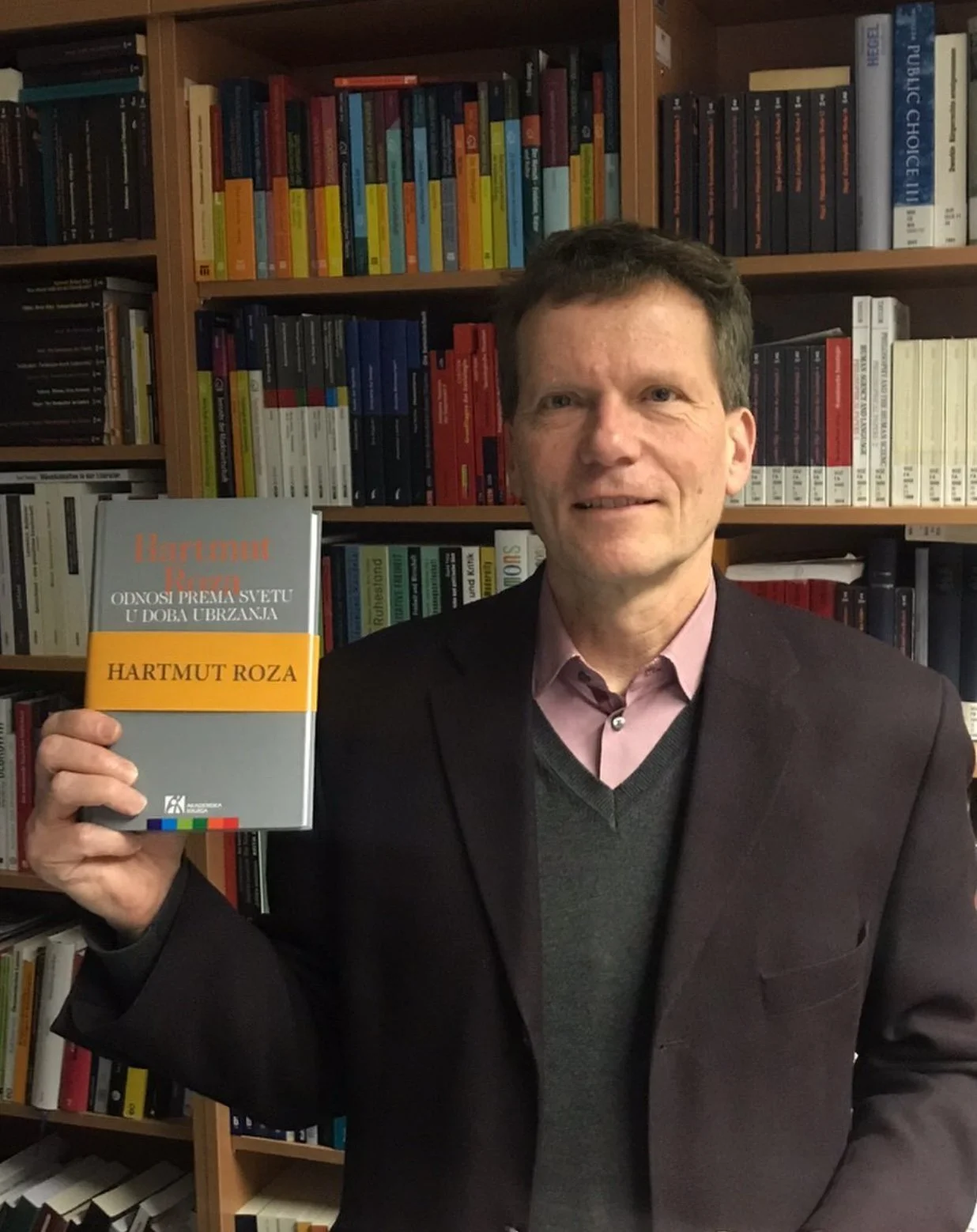
Prof. Dr. Hartmut Rosa (2020)
Instagram/@hartmut.rosa
When Your Skills Become Outdated Overnight
The second system of acceleration is the acceleration of social change, related to this first system of technological change. Prior to modernity, the way you boiled water, cooked food, performed daily tasks would probably remain the same: you may learn a trade, a skill or a fact about the world during your childhood that would remain true and useful to your grandchildren.
But nowadays, culture moves at a faster pace, and everything from fashion trends and predominant music genres to political ideologies is becoming harder and harder to keep up with: staying in this loop is almost laborious.
I usually explain it with an anecdote. Back in primary school, we had ICT lessons once a week in the computer room. I was a veritable computer whiz, being able to turn on the computer and the monitor, load Microsoft Word, or find myself on the Google homepage and search for something. Yet when I worked as a teaching assistant at a primary school in my twenties, children as young as seven were using a coding game to build their own off-brand versions of Super Mario!

Illustrative image
Pexels/RDNE Stock project
In other words, certain skill levels or practices are rendered obsolete by the changing relationship between technologies and their users. As social change accelerates, the time, in which our prior knowledge and experience can be considered to hold value, is reduced.
By the time my former students reach adulthood, it may be the case that their coding skills are deemed comparatively primitive, given developments in AI-assisted vibe coding. Progress (tongue firmly in cheek as the concept is invoked) has its casualties. We are reluctant to change, until we have little choice but to change to preserve what we have.
The Productivity Trap
For Rosa, the third system of social acceleration - the acceleration of the pace of life - can be understood as a feeling that we are always running out of time, that there are never enough hours in the day. Time is perceived as a scarce resource, as a commodity to be spent, and to be spent efficiently.
Rosa defines it as “an increase in the number of episodes of action or experience per unit of time, i.e., it is a consequence of trying to do more things in less time”. To explain this idea further, Rosa invites the reader to imagine a scenario where you spent two hours a week responding thoughtfully to a stack of a half-dozen letters. With the invention of e-mail, it would only take you an hour to do the same job. But that’s not what happens, of course: because you can now transmit your thoughts instantaneously across the world with the click of a mouse, you will spend those this time trying to get through forty or fifty emails instead of writing six letters, stopping after two hours as even more come flooding in.
In other words, we try to compress actions into the time we have, but this does not give us more free time, rather the feeling of being constantly able to do more, coupled perhaps even with a tinge of guilt about the fact that we have not. AI interventions into modern workflows may exacerbate this further - “you have two weeks to design and write this slide deck” may quickly turn into “get better at prompting, you have a day to generate this slide deck”!
Illustrative image
Pexels/Matheus Bertelli
The Problematic of Speed
The philosopher Bernard Stiegler is similarly concerned about what he terms the problematic of speed. He argued that social ruptures caused by technological innovations become so contracted with invention after invention that the technical system itself is characterised by metastability, a system of permanent innovation, whereby technologies transform themselves perpetually. According to Stiegler, the speed of technological development has continued to accelerate “dramatically widening the distance between technical systems and social organisation as if, negotiation between them appearing to be impossible, their final divorce seem inevitable”.
Impressively nihilistic given he was writing this in the mid-1990s, Stiegler saw that our “social systems are constantly misadjusted and challenged - thrown into question. In the twentieth and twenty-first centuries, this acceleration intensifies still further, resulting, today, in so-called disruption”. He argued that the structural goal (or inevitable consequence) of digital communications technology would be the strategic exploitation of information speeds “with the aim of creating legal and theoretical vacuums…a structural lack of knowledge”.

Bernard Stiegler (2016)
Wikimedia/ Berkeley Center for New Media
A few years before the mass adoption of broadband, Stiegler saw the internet of the future: paywalled access to news, important information obscured by low-effort slop, and the intention to automate away our propensity for autonomous thought and action - the erosion (and subsequent commodification) of our knowledge of how to do (savoir faire), knowledge of how to live (savoir vivre) and knowledge of how to think (savoir penser).
The Unified Digital Ecosystem
Digitalisation allows all previous technological automatisms to be unified, as the internet can be used to source all forms of media, online shopping, communication in both professional and leisure contexts. Therefore, most interactions of the information age are mediated through screens, and these contexts are not clearly separated.
For Stiegler, the result is “total automatisation” as public authorities, social and educational systems, intergenerational relations and prior means of social formation are all disregarded, disintegrated or subordinated to the digital to remain relevant, and deprived of their ability to fully understand how they are incorporated into the broader technical configuration of social life.
The good news is that although these tendencies are structural, they are by no means inevitable. The allure of the technology treadmill is genuine – new technologies are exciting and perspective-shifting and allow us to feel as though we are living through important times. Convenience is seductive; easy solutions to old problems are seldom unwelcome. However, just because we are being compelled to move faster does not mean we are headed in any particular direction – we still require a collective understanding of where we are going and what we intend to achieve together, and AI advances in isolation do not answer those harder questions. In other words, being launched forwards does not guarantee a safe landing!