
Armenian Election: Victory for Pashinyan as Russia’s Coercive Election Playbook Fails Again to Sway Voters
By Ewan Thomas-Colquhoun, Natasha Kondrashova
Embattled Armenian PM Nikol Pashinyan has emerged as the victor in the country’s parliamentary elections. The results indicate that his Civil Contract party gained 49.81% of the vote, down from the landslide victory in 2021, yet still enough to maintain a slim majority in the country’s parliament. Local reporting has shown turnout at 58.97%, a near ten percent increase from the previous election, following five years of deep uncertainty in the South-Caucasian republic.
Armenian-Russian billionaire Samvel Karapetyan’s new opposition party, Strong Armenia, failed to inspire enough voters to seriously challenge Civil Contract, despite extensive support from a Kremlin-backed media and influence campaign directed against the incumbents. With 23.29% of the vote, Karapetyan’s defeat represents the latest in a series of setbacks for pro-Russian political actors across Europe, extending a trend that recently saw Viktor Orbán lose power in Hungary earlier this year and Maia Sandu able to advance Moldova’s EU accession aspirations at 2024 elections.
Despite Pashinyan’s support having weakened significantly in comparison to his landslide win at the previous elections, now down ten seats, this victory will be taken as a vindication of the bold course the administration has taken since 2021 to engage more deeply with Europe and the US.
Armenia's Pivot West: Putin Threatens with ‘Ukrainian Scenario’
Following Russia’s decision to decline support for Armenia in its conflict with Azerbaijan, Yerevan has frozen its membership of the Russian-led Collective Security Treaty Organisation (CSTO), Russia’s security bloc designed as an answer to NATO, and has sought alternative economic and security partners.
It was in the United States, therefore, that the administration brokered its Agreement on Establishment of Peace and Inter-State Relations with Azerbaijan, choosing mediation with American, rather than Russian diplomats, in a clear break from the previous Russian-led negotiation formats. Pashinyan’s administration has also come to key agreements with the U.S. Secretary of State Marco Rubio on the “Trump Route for International Peace and Prosperity” through Syunik province, alongside recently signing a comprehensive strategic partnership charter and several cooperation agreements with Washington.
May also saw the first ever EU-Armenia summit — seen as a key step for the countries’ deeper engagement with the bloc, with the European Union committing to expanding trade and investment with Armenia in the coming years. Such support could be crucial as relations with Russia have rapidly deteriorated in recent months. The chummy scenes of Pashinyan accompanying President Macron in a rendtion of La Boheme at the summit, could not be further from the icy meetings between President Putin and Pashinyan of recent times.
The Russian President has taken to reminding the Armenians of the ‘Ukrainian Scenario,’ a not-too-subtle reference to the previous time a former Soviet country saught ties with the EU, and has introduced a number of economic sanctions against the country as a means to pressure them away from this novel course.
The Next Steps: Constitutional Reform?
The party’s aspiration will be to use this election result to move forward with their Real Armenia agenda, laid out in an address held by the PM in February last year and frequently promoted on the campaign trail. This doctrine aims at redefining Armenia through constitutional reform; limiting the State’s territorial claims to the country’s internationally recognised borders and explicitly moving on from a foreign policy tied to a national identity defined by its appeals to historical injustice.
Such a step is highly contentious, particularly among the internally displaced, those directly affected by the current conflict with Azerbaijan, and the diaspora population, which most directly connects its identity to the country’s troubled history.
For Pashinyan, however, such a move is essential for normalizing relations with neighboring Azerbaijan and Turkey, which saw a significant improvement following the peace agreement reached in Washington in 2025, and without which any discussion of EU integration remains entirely academic. His plan is to renegotiate Armenia’s economic position in the region, to become a trade bridge between Europa and Asia, and to use the prosperity this could afford as a means to rebuild national identity around being a developed, future-focused state.
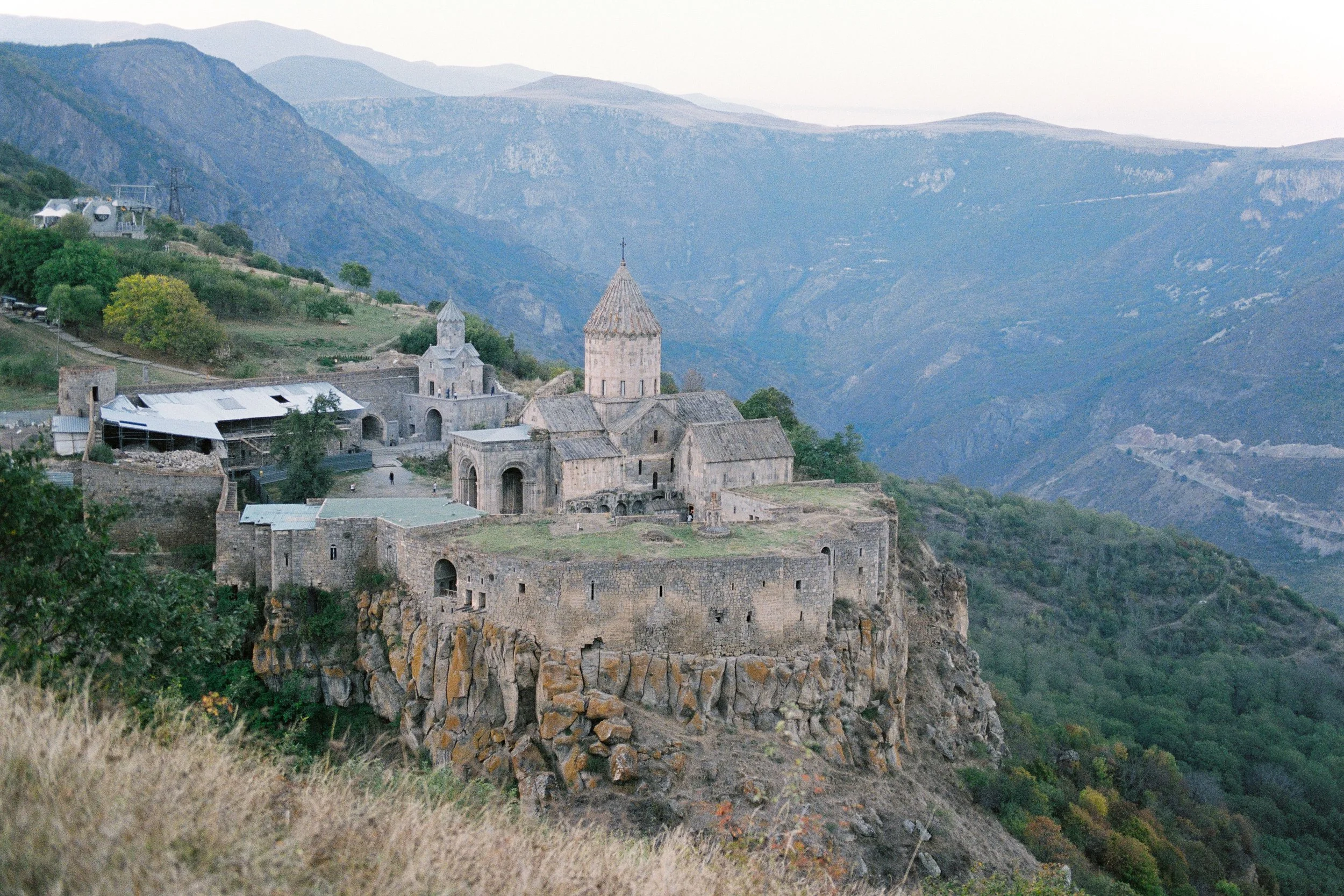
Tatev Monastery in Syunik Province, boarded by Azerbaijan and Iran
Vladimir Konoplev/Pexels
The truth behind the ideology, of course, is that Armenia has few other options if it wishes to reduce its strategic dependency on Russia – once seen as a source of security – but which, following the Velvet Revolution in 2018, has increasingly been used as a means to apply pressure on Yerevan to support Russia’s geopolitical agenda and to abandon its Western-facing policy.
The Cost of Turning West: Russia’s Campaign of Economic Coercion
In the days and weeks preceding the election, therefore, Russia has turned to its standard playbook of coercive strategies in an attempt to defeat Pashinyan’s new direction at the ballot box.
Recent weeks saw Russia ban the import of a range of Armenia’s agricultural produce and alcohol, in the Kremlin’s largest escalation of trade disputes since its counter-sanctions against the European Union. At the same time, Russia’s Foreign Ministry explicitly threatened to suspend Armenia’s agreement with the country on energy imports — an essential lifeline in a country 80% reliant on Russian oil and gas.
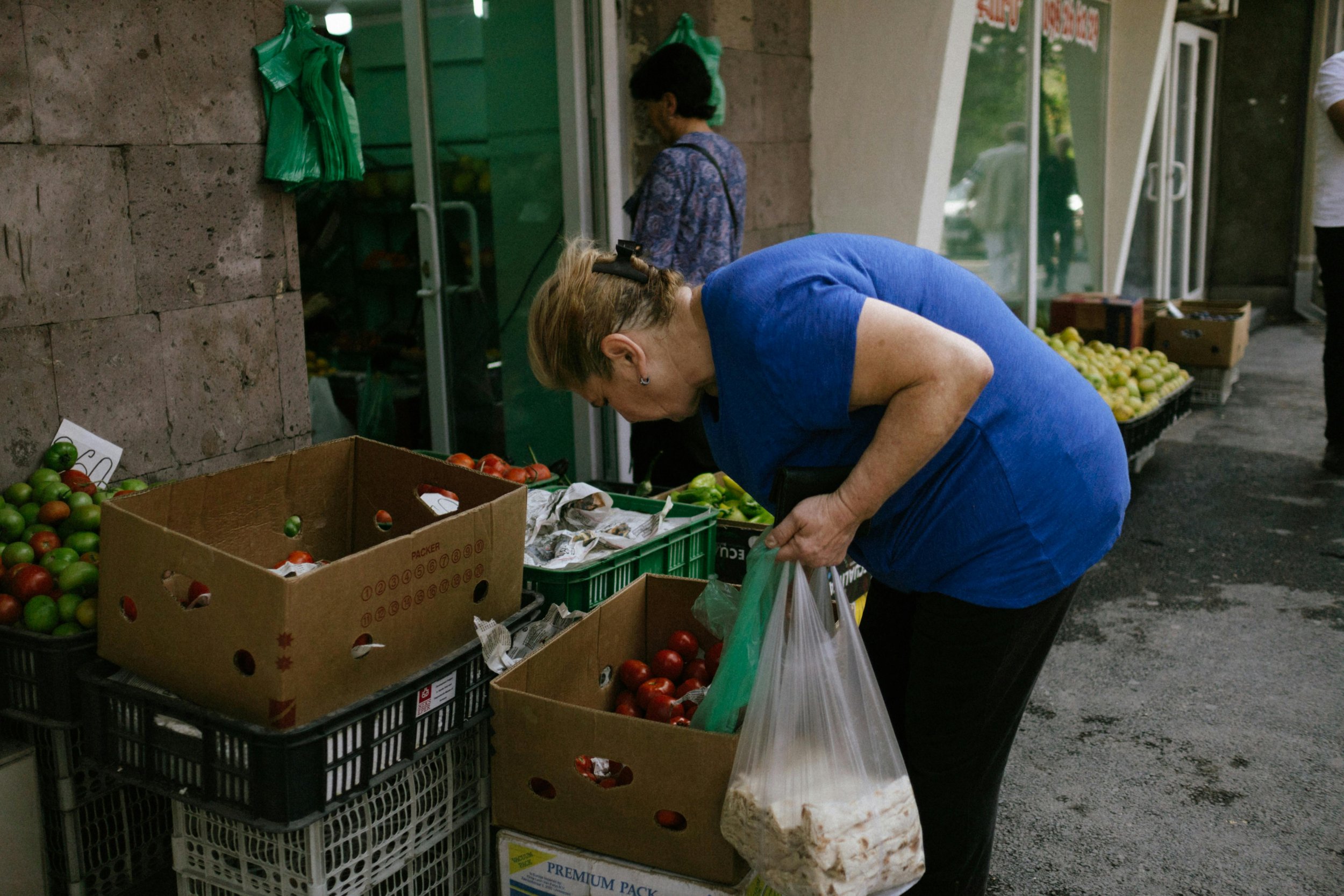
Woman selecting fresh vegetables and fruits at an outdoor market in Yerevan
Liza Bakay/Pexels
Armenia’s membership of the Eurasian Economic Union, Russia’s answer to the EU’s free trade zone, was also directly called into question at the May summit this year in Astana, with Belarus, Kazakhstan and Kyrgyzstan joining Russian criticism of the country’s dual foreign policy. The collapse of this relationship could be particularly damaging, as the bloc accounts for the vast majority of Armenia’s foreign trade, and has seen volumes nearly double since 2022 as Armenia has emerged as a sanctions-busting corridor for Moscow.
Matryoshka: Disinformation in Armenia as a Russian Doll
Since at least October last year, Russia has also been actively employing its disinformation strategies against the Armenian public in what European observers term a “Matryoshka” operation. Derived from the Russian term for its nesting dolls, the name is an ironic reference to the layers of false and amplification accounts used by operatives to spread false narratives – the standard approach from Russia’s – now well-studied – election interference playbook.
In Armenia’s case, disinformation followed the same formula as in previous European elections. Web pages of foreign and domestic news outlets were forged to spread fabricated stories alleging Pashinyan’s corruption, money-laundering, and meetings with shadowy European intermediaries. These were then complemented with AI-generated content warning about the dangers of European integration, arguing that Western orientation could mean war, energy poverty, and the loss of Russian protection.

Fake videos generated and spread by pro-Kremlin bots as part of a disinformation campaign against Pashinyan
Agentstvo. News (Агентство. Новости)/ Telegram
As with the Moldovan election, once the content has been generated, it is amplified. Networks of larger accounts to share it to much wider audiences within minutes – with foreign journalists frequently contacted to “verify” the content, as a means to push the fabrications into professional media discussions and get them into mainstream coverage that way.
The Politics of Pashinyan: How to Beat the Kremlin’s Candidate
With these significant diplomatic and covert resources invested by the Kremlin into defeating Pashinyan – the incumbent’s victory is particularly damaging for Putin – who sees returning Russian hegemony over the countries of the former Soviet Union as critically important to the stability of his regime. The Prime Minister’s victory, as with Moldova and Hungary before it, serves, therefore, as an example of how effective politics can outweigh the significant informational and financial backing provided by the Kremlin to its favoured candidates.
At the heart of Civil Contract’s success is Pashinyan’s understanding of contemporary politics; combining both grassroots campaigning with a consistent social media presence – appealing to voters on- and offline.
Learning from his successes during the Velvet Revolution, Pashinyan has used tours of Armenia as a means to generate support in towns and villages far beyond Yerevan, understanding, as Peter Magyar in Hungary, that credibility is built through presence. The perception of a politician who can listen and respond to citizens’ concerns – through the accessibility of his movement – was effective in countering the oligarchic politics of his opponents, viewed as largely out of touch due to their vast personal wealth.
Nikol Pashinyan taking a coffee break in Aparan @nikolpashinyan_official/Instagram
This was combined with an accessible and consistent social media presence, frequently posting personal videos from his own account of himself playing music, cycling, or spending time with his family; a format recognisable for political audiences native to social media platforms. Pashinyan has learnt the lesson of contemporary politics, that attention and authenticity online are becoming an essential political resource.

Nikol Pashinyan’s video
@nikolpashinyan_official/Instagram
Finally, the Pashinyan’s administration was able to come into the election prepared and ready to rebuke the Kremlin’s narratives – framing the threats and coercion as negative campaigning, and criticising the opposition’s campaign struggle to articulate a future beyond a return to Moscow’s orbit. Pashinyan, by contrast, had spent months elaborating a forward-looking economic case: an Armenia repositioned as a trade corridor between Europe and Asia, a prosperous and modern state built around its geography rather than its grievances. The contrast between a politics of the future and a politics of fear proved decisive.
The lesson from Yerevan, as from Chișinău and Budapest before it, is a consistent one. Coercion and the amplification of fear are formidable political tools within the Russian playbook – but the political reality has changed since 2014.
On the one hand, the perception of a political pathway in partnership with Russia has been irreparably damaged by the country’s expansionist policy in the region, with threats and coercion credible but unpersuasive for post-Soviet electorates. On the other hand, politicians have emerged who understand Russia’s threat and have developed strategies for defeating it. For Pashinyan, this has been a commitment to democratic ideals, a civil contractwith the electorate to find a new path for Armenia – rather than returning to Russia’s orbit.