
Why Do Engineering Students Need Ethics?
In 2014, a psychologist at Cambridge University, Aleksandr Kogan built a personality-quiz app that used Facebook’s developer API. Only about 270,000 people actually installed his app, but the API (at the time) also handed over data on the friends of anyone who installed it.
Such was the mundane scenario of a routine privacy breach which allowed the data of roughly 87 million users to end up harvested. That data was passed to Cambridge Analytica, a British political consulting firm, and used to build psychographic profiles for targeted political messaging around the 2016 US presidential election and the Brexit referendum.
No hacking skills required - the platform worked as designed, and the “friends’ data” permission existed because it made third-party apps more useful and viral. But no-one had thought about what it meant once the app in question was able to collect political-personality data at scale.
A technologist trained only in “how” and never in “who this affects” is liable to cause unintentional harm through sheer inability to see any of it coming, and likely to misjudge how a system will behave once it's out in the world. Fortunately, there’s a practical solution - and its roots go back to the Industrial Revolution.
What Anarchists Can Teach Us
Prior to industrialisation, a craftsman typically conceived of a whole object and made it. The productive processes of agrarians and artisans soon gave way to the tension between men and their machines. Workers left self-paced farming to work by clocktime and whistles. Millions moved from rural fields into crowded, polluted urban areas and worked with temperamental, hazardous machinery. Factories introduced a stark division of labour, and education mirrored and reinforced that split.
The 19th century anarchist movement was effusive in their criticism: a society which trains one class of people purely in intellectual work (planning, directing, deciding) and another class purely in manual or technical work (executing, building, operating) is both inefficient and manufactures (pun intended) a hierarchy. State and church-run elementary education for the working class emphasised discipline, obedience, rote literacy, and just enough technical training to make a docile, productive workforce, while a separate track of secondary and university education (reserved largely for the propertied classes) provided the sciences, classics, and philosophy needed to manage, invent, and govern.
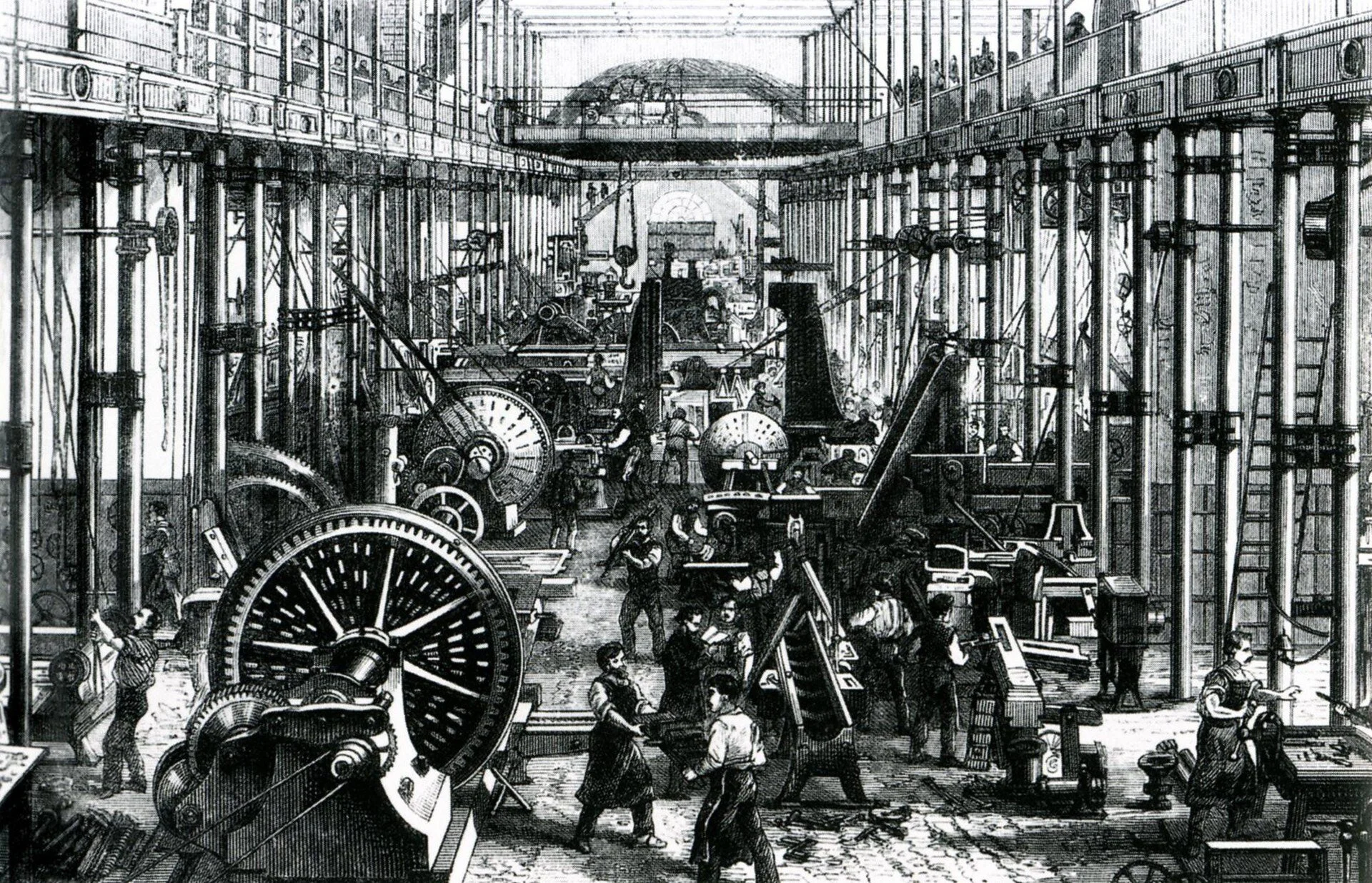
This image illustrates the machine works of Richard Hartmann in Chemnitz, one of the largest employers in the Kingdom of Saxony.
Wikimedia
The anarchists argued for an alternative. Integral education insists every person should receive both - enough manual and technical training to understand production, and enough intellectual and scientific training to understand consequence and direction.
Why Modern IT- Developers Are More Like 19th-Century Factory Workers Than They Realise
Thankfully we no longer live in the darkest days of the industrial revolution - universal public education affords the opportunity for all children to learn a diverse array of subjects for the holistic development of their faculties. But the philosopher Bernard Stiegler argues that technology always evolves faster than human culture, creating a permanent state of disruption, a structural lag where societies are always changing before people can adapt. Because digital algorithms and automation now move at hyper-speed, societies are caught in a constant loop of social and regulatory catch-up. Every technological revolution produces the same casualty: people skilled enough to build a system without the means to see past their own piece of it.
Historically speaking, we have only just arrived in the world of screens - we learned to type, to interact with computer systems; and yet we must continuously retrain, relearning our jobs as markets react to fast-evolving software changes. Moreover, developed economies shifted from manufacturing toward information - what Daniel Bell called the post-industrial economy and Manuel Castells later described as a network society - organised around nodes and flows rather than fixed hierarchies, where power increasingly resides in those who design, own, and control the protocols, platforms, and algorithms that structure communication, commerce, and social life.
This creates a new version of the old split: a technologist who writes efficient code, trains a model, or optimises an interface may be as narrowly instrumentalised as a 19th-century factory worker, especially if they lack any framework for understanding the social, political, or psychological effects of the systems to which they contribute.
Harm by Design?
Kogan's app, mentioned at the beginning of this article, is just the tip of the iceberg. There are some of the hard lessons learned in the wider industry over the past decade about what happens when powerful technology outpaces ethical foresight.
In 2017, Joy Buolamwini and Timnit Gebru tested three commercial gender-classification systems - from Microsoft, IBM, and Face++. They checked what the industry’s own benchmark datasets looked like and published a Gender Shades study a year later. They found those benchmarks were overwhelmingly composed of lighter-skinned subjects - about 80% of one and 86% of the other, so the “97%+ accuracy” companies advertised was true on a population that wasn't representative to begin with.
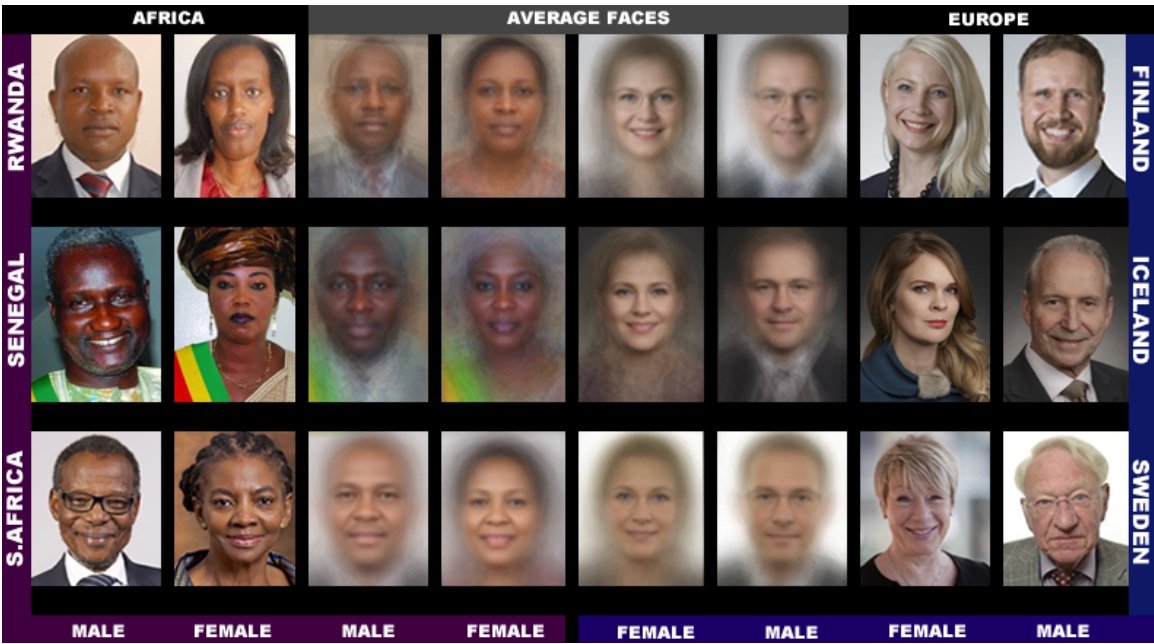
A screenshot from Buolamwini and Gebru’s research paper ‘Gender Shades: Intersectional Accuracy Disparities in Commercial Gender Classification‘. They explain that this images shows “average faces from the new Pilot Parliaments Benchmark“.
They built a new, more balanced test set using the Fitzpatrick skin-type scale used by dermatologists, and re-ran the systems. Darker-skinned women turned out to be the most misclassified group, with error rates up to 34.7%, while the worst error rate for lighter-skinned men was 0.8% - roughly a 40x gap.
These error patterns were not the result of sloppy engineering, given that these were state-of-the-art neural nets by the standards of their day, but they failed to consider the social implications of working with a misrepresentative benchmark dataset - i.e., nobody asked “accurate for whom?” The fallout was substantial: a few years later, IBM announced they were leaving the facial recognition market citing racial profiling concerns.
Another example dates to 2022, when the UN's Independent International Fact-Finding Mission described social media’s role as “significant” in spreading hate speech during the Rohingya genocide in Myanmar. It was a systematic military campaign of mass violence and ethnic cleansing launched by Myanmar’s military against the predominantly Muslim Rohingya minority in Rakhine State, peaking in August 2017. Soldiers and local mobs engaged in mass killings, sexual violence, and the burning of entire village. By 2020, over 730,000 Rohingya people were forced into refugee camps in neighbouring Bangladesh, and Myanmar’s military leadership have since faced genocide charges at the International Court of Justice.

Rohingya refugees at a refugee camp in Bangladesh.
Screenshot from the Voice of America video “UN: Rohingya Refugee Crisis Faces New Emergency“ by Zlatica Hoke.
The UN’s Mission notes that Facebook had become “a useful instrument for those seeking to spread hate” in a country where, for most users, Facebook effectively was the internet. Mission chair Marzuki Darusman put it more bluntly at a UN briefing: social media had played a “determining role” and substantively contributed to acrimony and conflict. Facebook’s ranking and recommendation systems reward content generating the most engagement - pernicious in a market where hate speech was being systematically amplified and the company had only a handful of Burmese-speaking moderators to stem the tide.
How Digital Engineers Benefit from Ethics
In each of these famous cases, the technology cleared its own internal bar - the classifier was accurate on its test set; the API delivered the data it promised; and the ranking algorithm maximised engagement. Most of us live in a world increasingly shaped by a new kind of impoverishment, a lack of legibility: the inability to see, audit, or contest systems that are making consequential decisions about our lives. The good news for technologists is that they sit disproportionately on the side that can see how these machines work.
Students leaving with skills in machine learning, cybersecurity and software engineering are entering a job market where their technical skills are in extraordinary demand (AGI pending), and many will one day be in a position to design, deploy and build systems of their own.
I’m not suggesting that these tech firms shouldn’t hire internal policy teams or ethicists, nor claim to be capable of regulating themselves, but we must resist the temptation to make a sharp cut between digital engineers and those assessing social impact. Excellent, socially-minded technologists have never been so well positioned to make a positive difference to everyday lives. That’s why alongside technical competence, digital engineers must be empowered to make arguments about the social implications of digital technology. They need to be able to ask questions and understand potential social impact before those questions are asked by parliamentary committees or in court proceedings.
There are clear benefits to teaching ethics and social impact alongside digital engineering: firstly, it trains students to anticipate harm, as is the goal with recently developed Value Sensitive Design frameworks. Secondly, students are taught to see questions of political rights hiding under design choices - some of the most-cited papers from STS (Science & Technology Studies) demonstrate how decisions that appear purely technical actually encode highly political and partisan choices.
Thirdly, students will acquire the vocabulary to recognise structural effects in society while they are still happening - they can learn to ask, “is this design practice becoming the default - and should it?” while the choices remain malleable. Fourthly, a pragmatic consideration - ethics education strengthens the durability of digital products from the outset.
Finally, we must empower digital engineering students to feel confident in situations where they are no longer taking direction from someone else; the technologists of the future must be equipped to lead.
We must take the social implications of technology seriously - understanding the ethical frameworks that justify certain regulative measures and certain social phenomena that can be exacerbated or reduced by technology implementation is often mischaracterised as a constraint on ambition, but it should be seen as part of what an ambitious technological vision actually requires. Somewhere in a lecture hall right now, a student is learning to build a recommendation engine, harden a network against intrusion, or fine-tune a model on a sensitive dataset. In a few years, that same student may be the one deciding how that system works - more than how it’s coded, but also who it serves, who it excludes, and what practices are shaped and normalised by putting it out into the world.